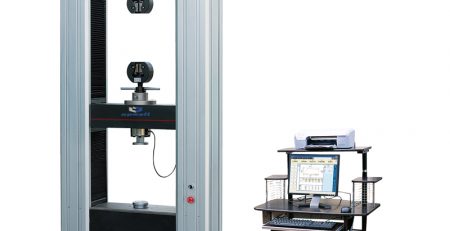
Deformation and displacement of material tensile testing machine are two concepts we often encounter in use. Deformation refers to the force generated by the sample under force during the test process, and its shape and size also change The phenomenon is called deformation, that is, the deformation of the test piece; and the more popular displacement is the distance that the beam moves in the testing machine from the beginning of the force (refers to the distance that the beam moves). In less demanding tests, displacement can be used instead of deformation. However, the beam displacement is not the actual and accurate deformation of the specimen. There is a certain difference between the data measured by the displacement and the data measured by the deformation. Moreover, there must be a relationship of less than or equal to deformation and displacement. If you want to measure more accurate deformation, you must use an extensometer.
During the use of the material tensile testing machine, if there is abnormal displacement, the user can refer to the following solutions to solve the problem, and do the inspection of the following three parts:
- Check the amplifier unit of the material tensile testing machine: After troubleshooting the displacement sensor, check whether the amplifier unit is normal. Disconnect the output signal of the amplifier unit first. Remove the output wiring, add a DC input signal to the amplifier unit through the workstation, and measure the output of the amplifier unit. After repeating several times, the measured output signal of the amplifier unit shows a linear trend to determine that the amplifier unit is normal.
- Check the system settings of the material tensile testing machine: the display in the workstation finds that the stroke of the actuator is only ±10mm, and it should be ±50mm under normal circumstances. If there is a problem with the system setting, the system needs to be reset. After resetting the stroke of the actuator to ±50mm, the displayed value on the display panel of the workstation is still incorrect. Therefore, it is believed that the fault can only be solved by re-marking the positioning and moving system.
- Check the displacement sensor of the material tensile testing machine: because the material tensile testing machine system is a closed-loop system, to determine which part of the system has a fault, first disconnect the loop in the system to make the system an open-loop system. If it is normal when the sensor signal is judged, the feedback signal of the displacement sensor must be disconnected to make the system an open loop. At this time, a control actuator movement signal is sent from the workstation, and then the sensor feedback value is measured. After several repetitions, when the sensor’s feedback data is measured as a linearly changing line, it is determined that the sensor is normal.
The material tensile testing machine is suitable for the tensile, bending, compression, peeling, tearing and other mechanical properties of various metal materials. The high-precision, multi-purpose material testing machine can accurately determine the physical properties of various materials under the above test conditions. Performance data, accurate digital processing, this machine is a computer-controlled advanced testing instrument.
Any further question please freely to contact us info@upwelltest.com 008615562578858