Vicat Softening Temperature
Applicable standards: ASTM D 1525, ISO 306, DIN 53460
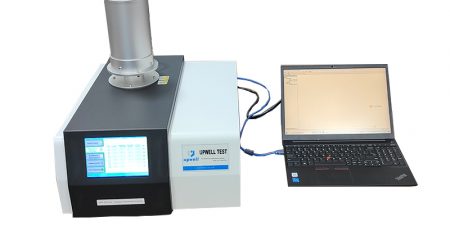
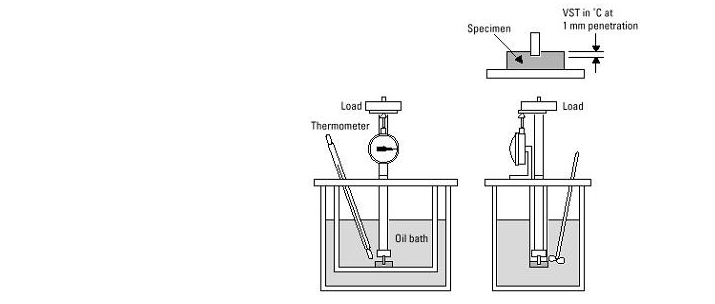
The test for Vicat softening temperature mainly determines the temperature at which a material softens rapidly. A plastic specimen is immersed in a liquid heat-transfer medium. Under a specified load and constant linear heating rate, the temperature at which a 1 mm² flat-tipped indenter penetrates 1 mm into the specimen is defined as the Vicat softening temperature (VST).
ISO 306 specifies two load grades:
- Grade A: 10 N load
- Grade B: 50 N load
Two heating rates are available: 50 °C/h or 120 °C/h. Combined designations A50, A120, B50 and B120 are commonly used in the ISO system.
The test specimen is submerged in a heated oil bath starting from an initial temperature of 23 °C. After a 5-minute hold period, a 10 N or 50 N load is applied to the specimen. The oil bath temperature is recorded as the VST when the indenter penetrates the specimen to a depth of 1 ± 0.01 mm.
Heat Deflection Temperature (HDT)
Applicable standards: ASTM D 648, ISO 75, DIN 53461
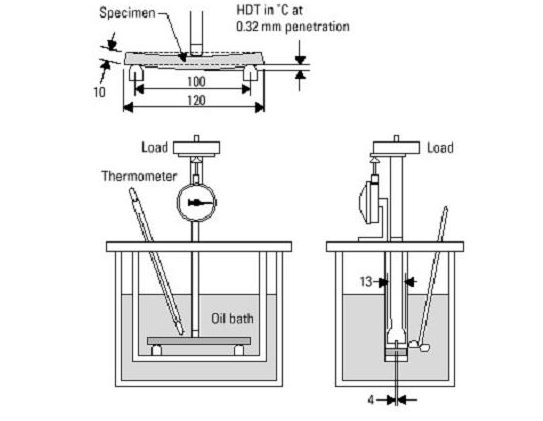
Heat deflection temperature characterizes a material’s short-term heat resistance under a specified load. This method measures the temperature at which a test specimen, immersed in a suitable liquid medium heated at a constant rate and subjected to static flexural load in a simply supported beam setup, deflects to a specified threshold value; this temperature is the heat deflection temperature.
Under both ASTM and ISO standards, loaded test specimens are immersed in silicone oil equipped with heating rods (see Figure 2). The pressures applied to the specimens are as follows:
- Low pressure: 0.45 MPa (per both ASTM and ISO standards)
- High pressure: 1.82 MPa (ASTM standard), 1.80 MPa (ISO standard)
After the load is applied to the specimen for 5 minutes, the deformation measuring device shall be adjusted to zero the deflection reading. This waiting period can be omitted if no obvious creep occurs in the material. Subsequently, the silicone oil is heated at a constant rate of 2 °C/min starting from an initial temperature of 23 °C (ambient temperature).
The heat deflection temperature of the test specimen is defined as the temperature at which the midpoint deflection of the specimen reaches 0.32 mm (ISO requirement) or 0.25 mm (ASTM requirement).
HDT is classified into two grades designated by letters A and B based on the magnitude of surface compressive load applied:
- HDT/A: load of 1.80 MPa
- HDT/B: load of 0.45 MPa
Comparison of HDT between Amorphous and Crystalline Materials
For amorphous materials, their HDT values are close to the material’s glass transition temperature (Tg). Amorphous materials do not possess a distinct melting point, and their processing is carried out in the rubbery state above Tg. Crystalline materials exhibit lower HDT values owing to the residual crystalline domains retained even at elevated temperatures.
HDT test results of amorphous materials show better repeatability compared to crystalline counterparts. Certain specific materials require annealing prior to testing to obtain valid measurement data.
In general, adding fiber reinforcements increases the HDT of plastics significantly. Fibers greatly improve the mechanical strength of plastics, leading to a sharp rise in HDT during the flexural resistance test under rising temperature. This HDT improvement effect from fiber reinforcement is more pronounced for crystalline materials than amorphous ones.
HDT cannot be used to define the maximum service temperature of a material. In real-world service conditions, the exposure duration, applied load and surface compressive stress differ substantially from those specified in standard test procedures.
Any interested or qutestion please contact us www.upwelltest.com or email: info@upwelltest.com