- Basic Principles of the Surge Tester
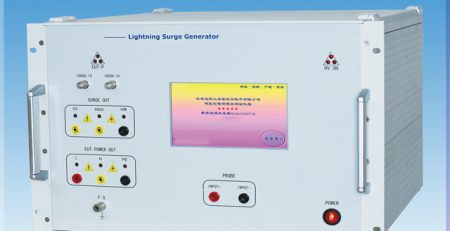
A surge tester is an advanced high-voltage power supply and measurement unit, involving complex electrical and electronic engineering knowledge. Specifically, the surge tester operates through the following steps:
Power Conversion:
The surge tester uses a standard 115V or 220V AC power supply and converts it to a higher voltage required for surge testing.
Voltage Rectification and Charging:
The higher voltage is rectified into a direct current (DC) voltage, which charges a large discharge capacitor. One end of the discharge capacitor is connected to the Device Under Test (DUT) through the output leads of the surge tester, while the DUT is also grounded to form a complete circuit.
Switch Control:
During the charging phase of the discharge capacitor, there are switches in the circuit that are open. These switches are typically Insulated Gate Bipolar Transistors (IGBT) or Silicon Controlled Rectifiers (SCR). When the discharge capacitor reaches the required voltage, the switches close for a period, preparing to generate a surge pulse.
Pulse Generation and Capture:
When the switches open again, the pulse energy is captured in the energy storage circuit between the tester capacitor and the inductive DUT. An oscilloscope is connected to the energy storage circuit to capture the waveform generated by the surge pulse.
Waveform Processing and Display:
As the voltage oscillates in the energy storage circuit, it gradually decays to zero volts due to the impedance in the circuit. The oscilloscope sends the captured waveform to a computer for loop processing, and the waveform is immediately displayed on the monitor. The entire process is completed within milliseconds, allowing for rapid and continuous generation and analysis of successive pulses.
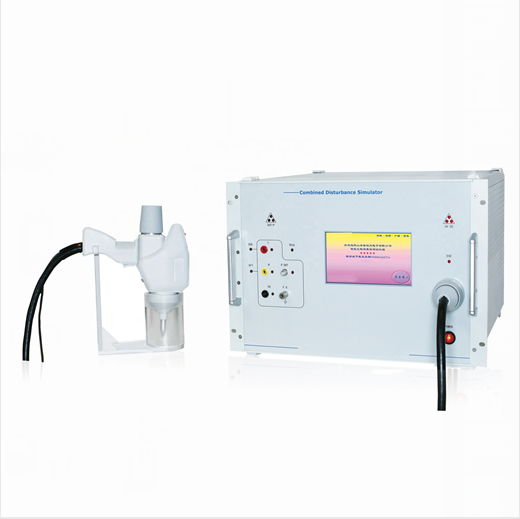
EMC Testing Device ESD EFT Surge combined Simulator
Applications of the Surge Tester
The surge tester has a wide range of applications in various fields, including but not limited to the following:
Power Industry
In power systems, transient surge currents can be generated due to lightning strikes, switching operations, motor startups, etc. These surge currents can damage electrical equipment. By using a surge tester, various equipment in power systems can be tested for surge current, problems can be identified in time, and appropriate protective measures can be taken to ensure the stable operation of the power system.
Industrial Sector:
Industrial equipment often needs to withstand various electrical interferences, and surge currents are a common form of interference. The surge tester can evaluate the surge resistance of industrial equipment, identify potential problems in time, and ensure the normal operation of industrial production.
Electronics and Communications:
With the continuous development of electronic communication technology, the requirements for the interference resistance of various electronic devices are increasing. The surge tester can test the performance of communication equipment under surge current conditions to ensure the stable operation of communication devices.
Household Appliances and Consumer Products:
The surge tester is also widely used in the electrical safety testing of household appliances and consumer products, ensuring that these products remain stable and safe when facing surge currents in the power system.
Automotive Electronics:
In automotive manufacturing, the surge tester plays an important role. It can test the stability and reliability of automotive electronic systems in complex electromagnetic environments, ensuring that automotive electronic systems can operate normally under various conditions.
In summary, the surge tester, through its unique principles and technology, plays an important role in multiple fields, providing strong assurance for the safe operation of electrical equipment.
Any interested please contact us WWW.UPWELLTEST.COM OR EMIAL INFO@UPWELLTEST.COM